11 December 2024
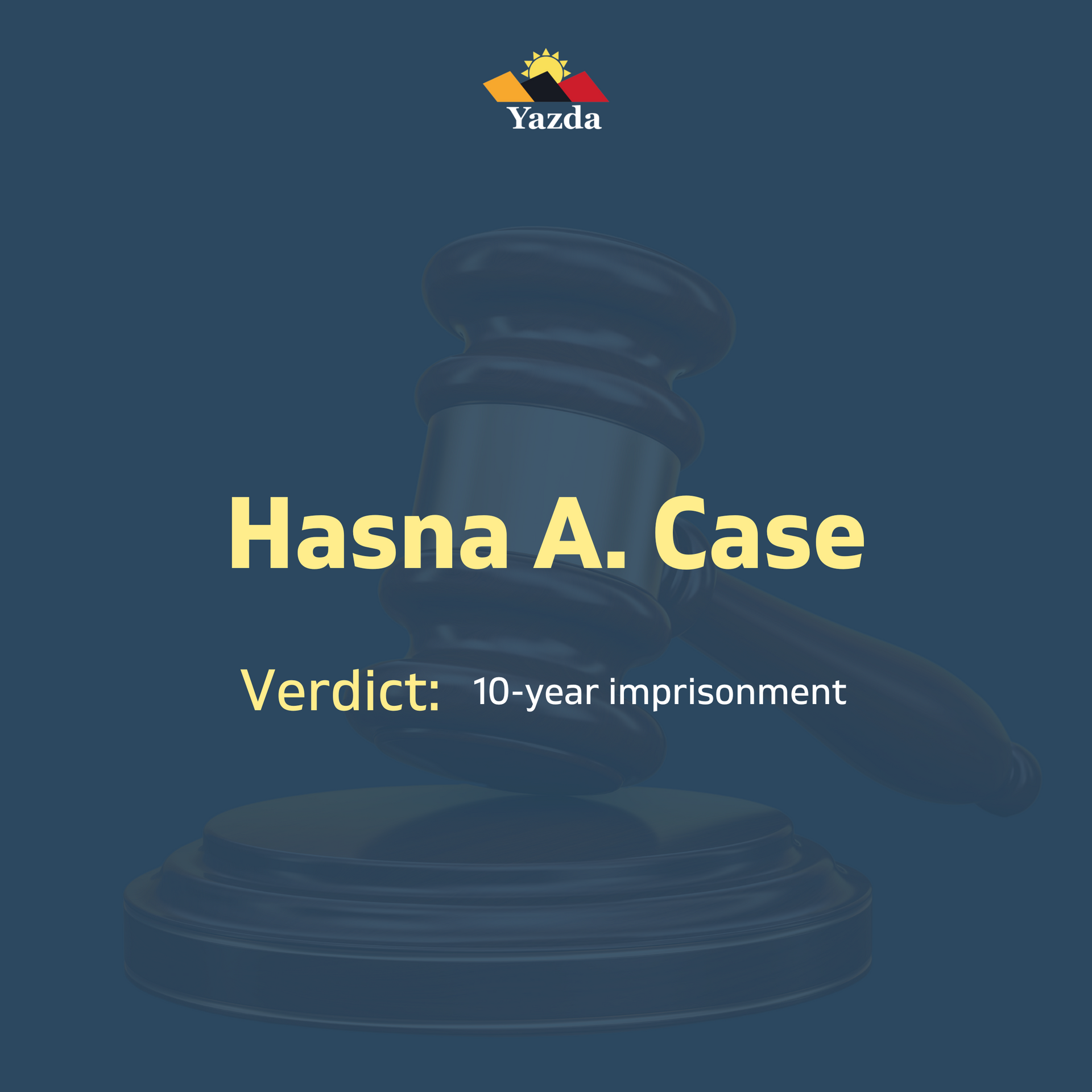
11 December 2024 Today, the international crimes division of the District Court of The Hague handed down the verdict in the Hasna A. case . It is the first trial in the Netherlands in which a member of the so-called Islamic State in Syria and the Levant (ISIL, also referred to as ISIS, IS, or by its Arabic acronym Daesh) has been convicted for crime committed against Yazidis. Hasna A., a Dutch national, travelled to Syria in 2015 with her four-year-old son, married an ISIL-member and lived in the ISIL-controlled city of Raqqa. She was tried for charges related to membership of ISIL, a terrorist group, as well as for endangering her son by bringing him with her to Syria and keeping him there. Importantly, Hasna A. also stood trial for the use of two Yazidi women as domestic slaves. The Yazidi women –referred to throughout the criminal proceedings only as ‘Z.’ and ‘S.’— had been enslaved by ISIL in August 2014. They were enslaved and kept in several houses where Hasna A. stayed whilst living in Raqqa in 2015 (Z.) and 2016 (S.), and Hasna A. forced them to perform domestic chores. Hasna A. also forced Z. to look after her four-year-old son. The slavery charges were brought against Hasna A. as crimes against humanity. Hasna A. is one of twelve Dutch women who had been repatriated from detention camps in Northern Syria at the end of 2022. She was arrested upon arrival in the Netherlands and taken into pretrial detention, appearing before the Trial Panel every three months. The Trial Panel had referred the case to the investigating judge and further investigation took place into the charges, which included hearing both Yazidi women as witnesses in 2024. The substantive hearings in the criminal proceedings against Hasna A. took place before the Trial Panel on 14, 16 and 17 October 2024. In today’s verdict, the court sentenced Hasna A. to a 10-year prison sentence for four offences: enslaving Z. in Syria in 2015, membership to the terrorist organization ISIL, promoting terrorist crimes and endangering her minor son. The court held that the enslavement of Z. amounted to a crime against humanity. The sentence is higher than the demand of the public prosecutor, who had demanded a prison sentence of eight years. The slavery charges against S. were not proven and Hasna A. was acquitted in relation to this offence. The verdict is available in Dutch and an English translation will be available soon. The two Yazidi survivors Z. and S. who participated in the trial as victims (survivors), injured parties and witnesses to the facts were accompanied by Yazda and supported throughout the process with translation, mental health and awareness support. The arrest, prosecution and trial of Hasna A. sends a clear message that, like other countries applying similar universal jurisdiction principles, the Netherlands will not be a safe haven for ISIL perpetrators. With today’s conviction, the Netherlands becomes the second country in the world to convict an ISIL-member for international crimes committed against Yazidis, looking beyond terrorism. Z. commented : "Our dream has finally come true, and we’ve achieved the result we longed for. This woman, Hasna A., caused us immense harm, and now it’s time for justice to prevail. Holding individuals accountable for their actions is a vital part of the justice process." S. added: "Honestly, I’m truly relieved to see justice finally served. However, a 10-year prison sentence feels insufficient and will never fully compensate for the suffering we have endured.” The outcome of this trial would have also not been possible without their legal representatives, Brechtje Vossenberg and Barbara van Straaten from law firm Prakken d’Oliveira Human Rights Lawyers in Amsterdam (the Netherlands). Brechtje Vossenberg commented: “It is thanks to the bravery and resilience of women like Z. and S. that the court was able to hand this verdict down and convict Hasna A. for the international crime of slavery committed against Z. Despite the disappointment that the charges relating to S. were unfortunately not proven, the verdict still marks another milestone in the long road to justice for the Yazidi community. It is the first of its kind here in the Netherlands and an important signal that the international crimes committed against Yazidis will be prosecuted here whenever possible. My clients’ participation in this trial was crucial to the establishment of the truth and the measure of justice that was obtained here today. I take my hat off to them both.” The Dutch court took a groundbreaking approach by providing online access to the substantive hearing sessions in both Dutch and Kurdish Kurmanji. This allowed survivors abroad and those who were unable to attend the hearings in person, to follow remotely both the substantive hearings in October and the pronouncement of the judgement today. Yazda facilitated screenings of the trial in Duhok (Kurdistan Region of Iraq) and Sinjar (Federal Iraq) where most of the global Yazidi community members currently reside. Around 40 members of the Yazidi community, including family members of one of the witnesses in the case attended the events and were, for the first time in a decade, able to witness justice in action. Following the verdict, one participant commented: “We want ISIL criminals to face fair sentencing, and we hope other countries will follow the Netherlands’ example in prosecuting these criminals.” Another added: “Other trials should be accessible online, and survivors in those countries should be invited to attend.” This trial is another milestone in the quest for justice by ISIL survivors. It is also only the 10th conviction worldwide of an ISIL member for crimes against Yazidis, a decade since the start of the genocide. Indeed, 9 convictions were handed down in Germany so far, including three for genocide. Recently, Sweden and France have initiated legal proceedings against alleged ISIL members for their involvement in crimes against Yazidis, signaling an important step in holding perpetrators accountable in a broader international context. However, the recent and abrupt closure of UNITAD on 17 September 2024 might jeopardize ongoing investigations and trials in third countries as the question of the accessibility of the evidence has still not been resolved. Natia Navrouzov, Executive Director at Yazda commented: "We commend the Dutch authorities and everyone who supported this case. Witnessing survivors follow the livestream of the verdict today from our offices in Duhok and Sinjar was a powerful reminder of the purpose behind our work, as it is ultimately for them. We are deeply proud of Z. and S., whose courage in coming forward made this case possible. While we are immensely relieved that Hasna A. has been convicted for her crimes, we had hoped the slavery charges concerning S. would also be fully acknowledged." ### Read the Arabic press release here. Download this English press release here. For media inquiries, please contact: Tonny Omondi Media and Communications Coordinator e: tonny.omondi@yazda.org About Yazda: Yazda is a non-governmental, non-profit organization that was established in 2014 in response to the genocide committed by the self-declared Islamic State (ISIS) against the Yazidis and other minorities in Iraq. Yazda manages a portfolio of humanitarian, justice, advocacy, and development-related projects, all of which are community and survivor-centered in terms of design and implementation. Since its inception, Yazda has been working with local and international partners to provide humanitarian, accountability, and advocacy services to vulnerable minority groups in Iraq in their post-genocide recovery. The organization has been operating in Iraq since October 2014 and has main offices in Duhok in the Kurdistan Region of Iraq and a branch office in Sinjar in Nineveh Province. Yazda is registered as a non-profit organization in the United States, the United Kingdom, Iraq, Kurdistan Region of Iraq. Over the past 8 years, Yazda has grown to employ around 80 staff on average, received support from numerous donors, both institutional and individual, and has reached tens of thousands of direct and indirect beneficiaries through its programs and initiatives.