Twelve Years On: Honoring Yazidi Victims and Calling for Justice
Date: 3 August 2026
Sinjar, Iraq: Today marks the twelfth anniversary of the Yazidi genocide perpetrated by the so-called Islamic State in Iraq and the Levant (ISIL). On 3 August 2014, ISIL launched a coordinated attack against the Yazidi people in Sinjar, Iraq. The Yazidi community was specifically targeted through mass killings, sexual violence, enslavement, forced displacement, and destruction of cultural and religious heritage. Thousands of Yazidis were abducted by ISIL and transferred to Syria and various locations of Iraq. These acts meet the legal thresholds of genocide, crimes against humanity, and war crimes under international criminal law.
On this solemn day of remembrance, Yazda stands in solidarity with the Yazidi people to honor the victims and survivors of the genocide. We remember those who were killed, those who remain missing, and the countless lives forever changed by these atrocities. Families were torn apart, entire communities were displaced, and the consequences continue to be felt across generations.
Twelve years later, hundreds of mass graves continue to be discovered, and around 2,500 Yazidis, predominantly women and children, remain missing to this day. Approximately 200,000 Yazidis have returned to Sinjar, while more than 200,000 remain displaced elsewhere in Iraq. Of those still displaced, around 180,000 Yazidis are living outside internally displaced persons (IDP) camps, and nearly 90,000 are residing in thirteen IDP camps. Decades of government neglect have compounded the challenges faced by the Yazidi community, contributing to the marginalization of this humanitarian crisis and leaving the fate of many survivors and displaced families without the support, security, and certainty needed to rebuild their lives.
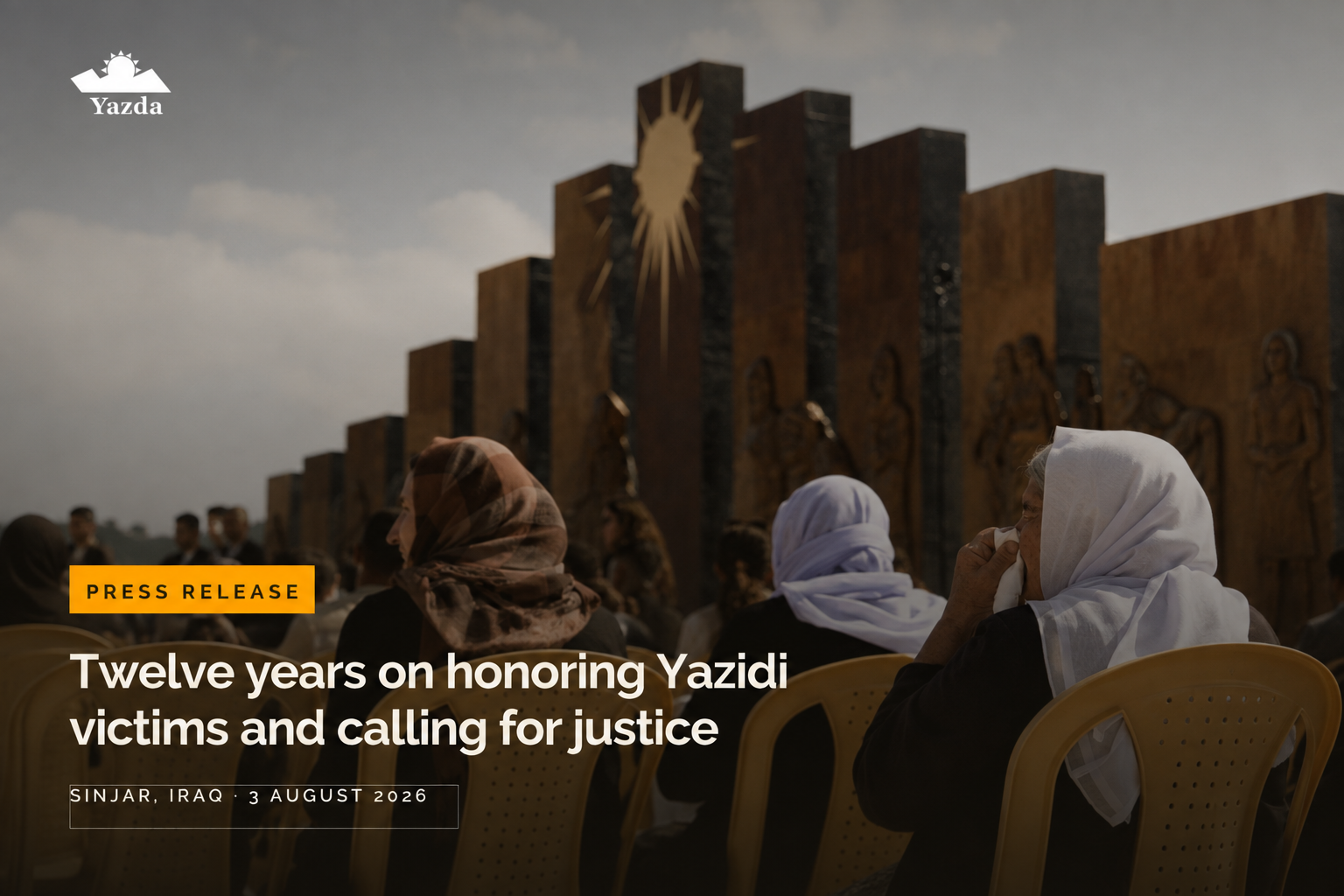
Today, a public tribute is being held at the memorial site of the Yazidi genocide in Solagh, Sinjar. Yazda joined survivors, families, supporters, and partners to commemorate the victims, honor the resilience of the Yazidi community, and renew the collective call for justice. This commemoration is more than a reflection on the past. It is a call to reaffirm Yazidi’s commitment to justice, accountability, and the protection of communities at risk.
This commitment to justice must also be reflected in concrete measures to support survivors and address the lasting impacts of the genocide.
Although the adoption of the Yazidi Survivors Law (YSL) in 2021 marked a historic step by establishing Iraq's first comprehensive administrative reparations program for survivors of ISIL atrocities, implementation remains incomplete. Since applications opened in September 2022, 2,587 applications have been approved, and with more than 2,216 survivors receiving monthly reparations. In addition, 262 land plots have been distributed, and 87 survivors have received educational support. However, many survivors whose applications were approved in 2025 have yet to receive financial benefits due to budget constraints, delaying access to essential reparations and undermining the timely delivery of justice.
Progress toward accountability has also been uneven. In Europe, a limited number of cases have been pursued under the principles of universal and active personal jurisdiction, demonstrating both the feasibility of prosecuting ISIL crimes under international law and the importance of political will. However, these efforts remain fragmented and dependent on factors such as the presence of suspects, access to evidence, and national legal frameworks. To date, fifteen cases have been pursued for genocide, crimes against humanity, or related offences, primarily in Germany, with additional proceedings in the Netherlands, Sweden, Belgium, Kosovo, and France. These cases demonstrate the critical role of national courts and survivor testimony in advancing accountability and preserving the historical record, while also highlighting the need for a more consistent and comprehensive approach to justice. In Iraq, prosecutions have continued primarily under counter-terrorism legislation, while no coordinated international mechanism has been established to core international crimes committed against the Yazidi community.
In light of the above, Yazda respectfully call for the following actions:
- Ensure the full and timely implementation of the Yazidi Survivors Law (YSL) by removing administrative and financial barriers, ensuring that all approved survivors receive their reparations without further delay.
- Adopt comprehensive legislation incorporating genocide, crimes against humanity, and war crimes into national law, ensuring that ISIL crimes are prosecuted in their full scope and that judicial proceedings contribute to truth-telling, reconciliation, and social cohesion.
- In parallel with domestic efforts, explore complementary international accountability pathways, including cooperation with the International Criminal Court (ICC).
- Strengthen efforts to locate, identify, and return missing Yazidis by increasing resources for the investigation and excavation of mass graves, supporting DNA identification processes, and providing families with truth and information about their missing relatives.
- Guarantee safe, voluntary, and dignified return for displaced Yazidis by improving security conditions in Sinjar, rebuilding destroyed infrastructure, restoring essential services, and ensuring meaningful participation of Yazidis in decisions affecting their future.
- Ensure continued international engagement and monitoring by governments, international organizations, and humanitarian actors to maintain attention on the Yazidi genocide and prevent future atrocities against vulnerable communities.
Twelve years after the genocide, justice for the Yazidi people remains an urgent responsibility.
The Yazidi community must never endure such atrocities again.
###
Download this Press Release here.
Read this Press Release in Arabic here.
For media inquiries, please contact:
About Yazda:
Yazda is a non-governmental, non-profit organization that was established in 2014 in response to the genocide committed by the self-declared Islamic State (ISIS) against the Yazidis and other minorities in Iraq. Yazda manages a portfolio of humanitarian, justice, advocacy, and development-related projects, all of which are community and survivor-centered in terms of design and implementation. Since its inception, Yazda has been working with local and international partners to provide humanitarian, accountability, and advocacy services to vulnerable minority groups in Iraq in their post-genocide recovery. The organization has been operating in Iraq since October 2014 and has main offices in Duhok in the Kurdistan Region of Iraq and a branch office in Sinjar in Nineveh Province. Yazda is registered as a non-profit organization in the United States, the United Kingdom, Iraq, Kurdistan Region of Iraq. Since its creation, Yazda has received support from numerous donors, both institutional and individual, and has reached tens of thousands of direct and indirect beneficiaries through its programs and initiatives.