Yazda Welcomes Iraqi Council of Ministers’ Approval of Draft International Crimes Law
26 August 2026
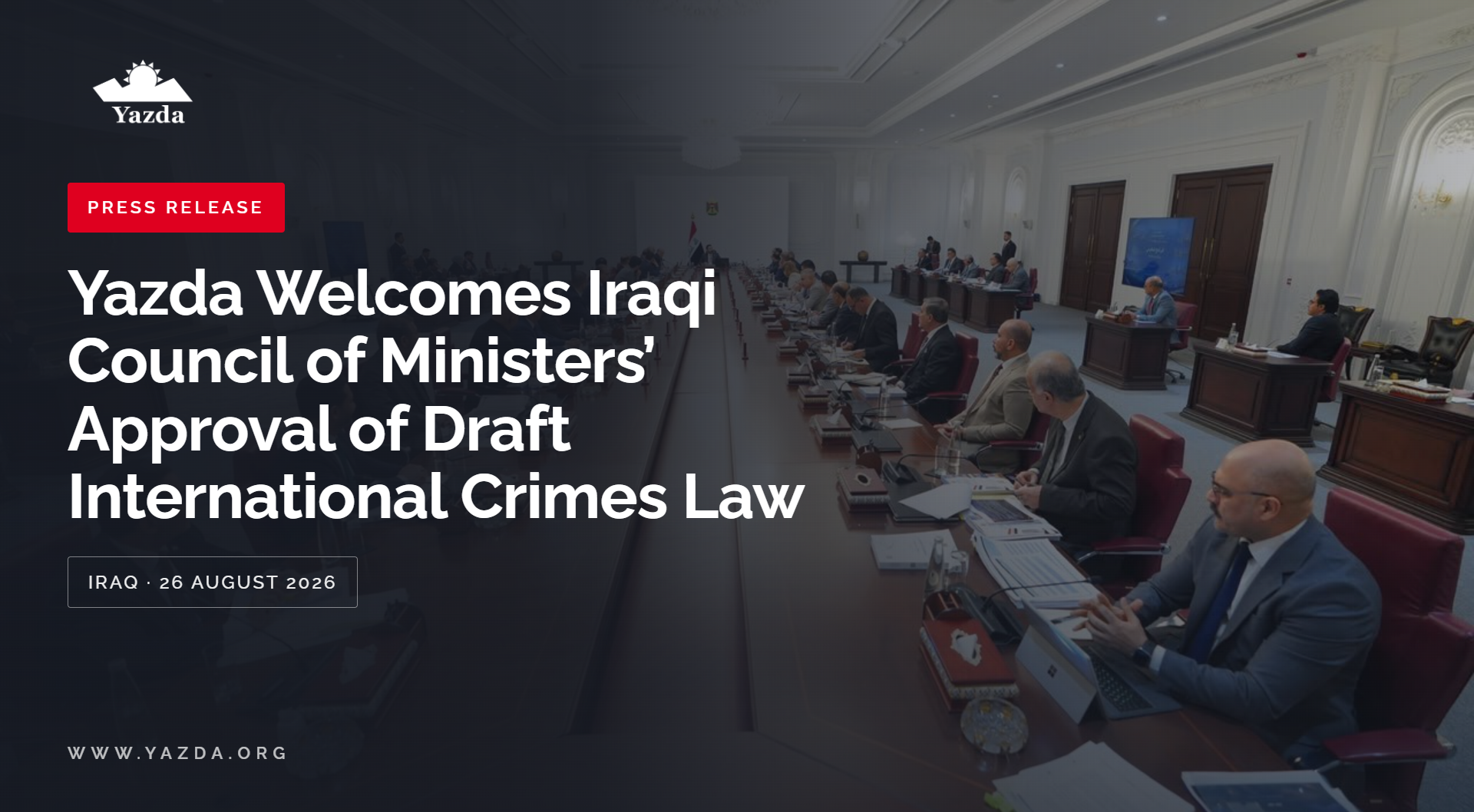
Iraq - Yazda welcomes the Iraqi Council of Ministers’ approval, on 24 August 2026, of the draft International Crimes Law and its referral to the Iraqi Council of Representatives following review by the State Council.
The draft law represents an important step toward establishing a domestic legal framework for the prosecution of genocide, crimes against humanity and war crimes in Iraq. If adopted by the Council of Representatives and brought into force, it could provide a long-awaited legal basis for prosecuting perpetrators for core international crimes committed by the Islamic State of Iraq and the Levant (ISIL).
For years, Yazda, survivors, victims’ families and civil society organizations have advocated for an Iraqi legal framework capable of reflecting the nature, gravity and scale of the crimes committed by ISIL against the Yazidi community and other affected communities.
To date, ISIL members in Iraq have largely been prosecuted under counter-terrorism legislation, as Iraqi criminal law does not codify genocide, crimes against humanity and war crimes as distinct offences. These proceedings have therefore generally focused on terrorism-related offences rather than establishing individual criminal responsibility for the specific international crimes committed against Yazidis and other affected communities. The recent transfers of ISIL detainees from northeastern Syria to Iraq have created a renewed opportunity to address this accountability gap and ensure that those suspected of core international crimes can be prosecuted for the full scope of their conduct. This makes the establishment of an appropriate domestic legal framework all the more urgent.
In the absence of such a domestic framework, proceedings in third countries have played a critical role in advancing accountability. Cases before European courts have resulted in prosecutions and convictions for genocide, crimes against humanity and war crimes and, importantly, have provided some survivors with opportunities to participate meaningfully in proceedings concerning the crimes committed against them.
These cases have demonstrated that ISIL atrocities can be successfully prosecuted as core international crimes and have contributed to establishing a judicial record of the Yazidi genocide. However, third-country prosecutions can reach only a limited number of perpetrators and depend on factors such as jurisdiction, the location of suspects and the availability of evidence. Establishing an effective framework in Iraq is therefore essential to creating a more comprehensive and sustainable pathway to justice.
In 2022, Yazda and the Coalition for Just Reparations (C4JR) published the Position Paper on an ISIL Accountability Mechanism in Iraq. Developed through extensive discussions among C4JR members and informed by survivors’ views, Iraqi and international law, and lessons from previous accountability processes, the paper set out recommendations for a survivor-centered mechanism capable of addressing genocide, crimes against humanity and war crimes committed by ISIL. It emphasized that survivors should be meaningfully involved and that their rights and needs should be respected throughout criminal proceedings.
The Council of Ministers’ approval of the draft International Crimes Law is an important step toward addressing this longstanding accountability gap. The draft has now been referred to the Iraqi Council of Representatives, where it will enter the parliamentary legislative process.
Parliamentary consideration and the required readings will follow in accordance with applicable procedures. At the time of publication, a date for the first reading has not been officially announced.
As Parliament considers the draft, Yazda calls on lawmakers to ensure that the final legislation meets the needs of survivors and victims and provides an effective basis for accountability.
In particular, Yazda calls on the Council of Representatives and relevant Iraqi authorities to:
1. Ensure meaningful survivor and civil society participation. Survivors, victims’ families, civil society organizations, and Iraqi and international experts should have genuine opportunities to contribute their expertise and recommendations during the parliamentary process.
2. Embed survivor-centered safeguards in the legal framework. The law and its implementation should protect the safety, dignity, privacy, and physical and psychological well-being of survivors and victims, including survivors of conflict-related sexual violence and children affected by ISIL crimes.
3. Guarantee meaningful participation in criminal proceedings. Survivors and victims should have appropriate opportunities to participate in proceedings concerning crimes committed against them, be heard, receive information about proceedings, and exercise their rights in accordance with international standards.
4. Ensure access to reparations. The legal framework should provide effective avenues for victims and survivors to seek appropriate forms of reparation and complement existing Iraqi mechanisms for reparations and survivor support.
Natia Navrouzov, Yazda’s Executive Director, said:
“This is a significant moment for survivors who have waited more than a decade to see the crimes committed against them addressed for what they are. For years, survivors have travelled abroad, testified before foreign courts and contributed to cases far from their homes in order to pursue justice for genocide, crimes against humanity and war crimes.
Iraq now has an important opportunity to build on those efforts and create a pathway to justice closer to the communities most affected. The measure of this law will not simply be the crimes it recognizes on paper, but whether survivors can access justice through it in practice.
Survivors, victims’ families and civil society have brought the accountability process this far. Their experience should now help shape a law that can deliver meaningful justice in Iraq.”
Yazda calls on the Council of Representatives to prioritize consideration of the draft International Crimes Law and stands ready to engage with Parliament, relevant Iraqi authorities, survivors, C4JR members, civil society organizations and other stakeholders throughout the legislative process.
###
Download this Press Release here.
Read this Press Release in Arabic here.
For media inquiries, please contact:
About Yazda:
Yazda is a non-governmental, non-profit organization that was established in 2014 in response to the genocide committed by the selfdeclared Islamic State (ISIS) against the Yazidis and other minorities in Iraq. Yazda manages a portfolio of humanitarian, justice, advocacy, and development-related projects, all of which are community and survivor-centered in terms of design and implementation. Since its inception, Yazda has been working with local and international partners to provide humanitarian, accountability, and advocacy services to vulnerable minority groups in Iraq in their post-genocide recovery. The organization has been operating in Iraq since October 2014 and has main offices in Duhok in the Kurdistan Region of Iraq and a branch office in Sinjar in Nineveh Province. Yazda is registered as a non-profit organization in the United States, the United Kingdom, Iraq, Kurdistan Region of Iraq. Since its creation, Yazda has received support from numerous donors, both institutional and individual, and has reached tens of thousands of direct and indirect beneficiaries through its programs and initiatives.