Yazda Testifies at the Paris Assize Court in France’s First Yazidi Genocide Trial
Date:
19 March 2026
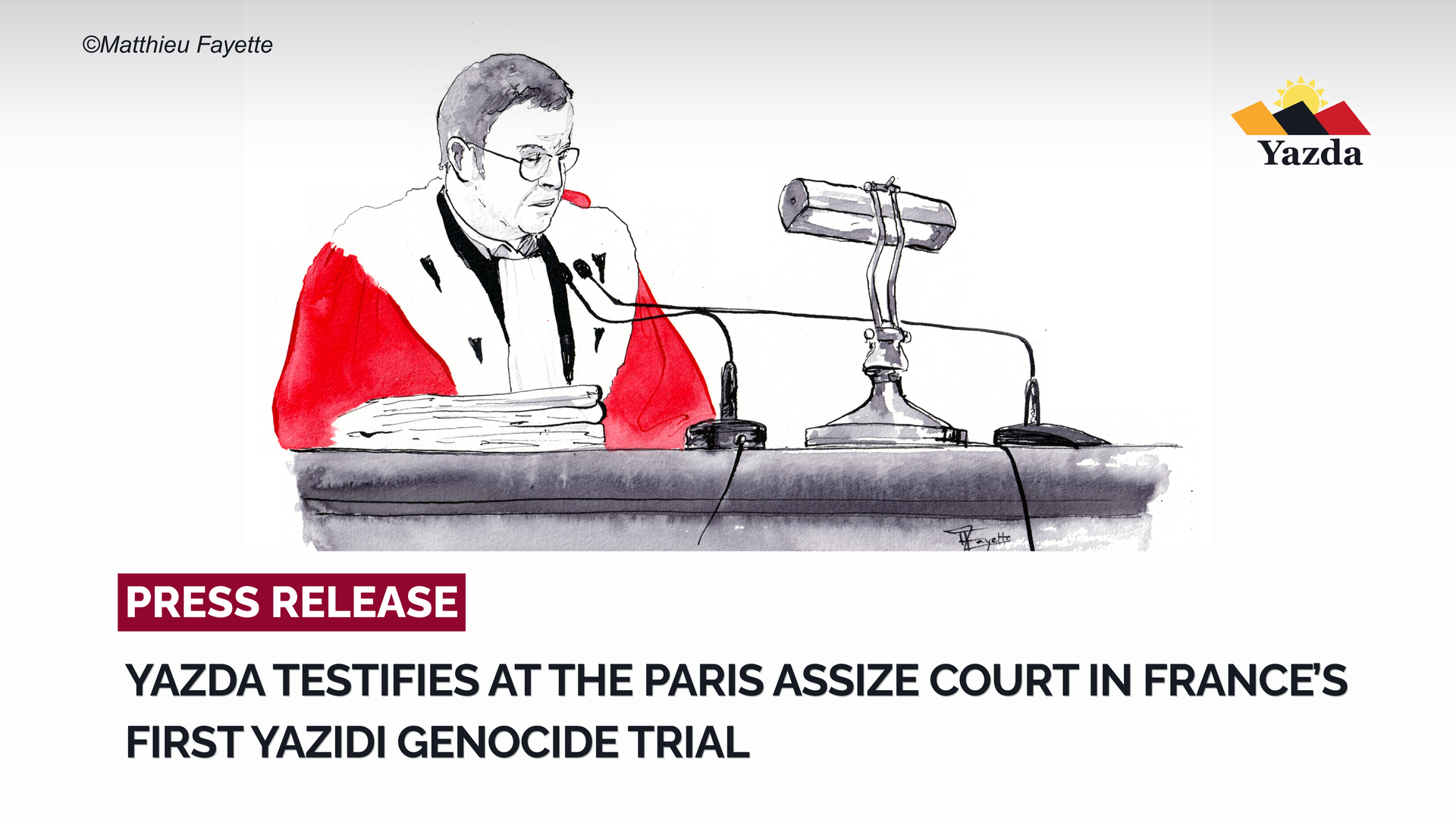
Paris, France – On 17 March, Yazda’s Executive Director, Natia Navrouzov, testified before the Paris Assize Court in the trial of Sabri Essid, the first case in France addressing charges of genocide and crimes against humanity committed by the Islamic State in Iraq and the Levant (ISIL) against the Yazidi community.
This landmark trial marks a moment of profound significance for the Yazidi people and represents a critical step toward justice and accountability.
Speaking both as Yazda’s Executive Director and as a member of the Yazidi community, Navrouzov recalled how Yazidis have grown up with a collective memory of repeated persecution and genocide, shaping her lifelong commitment to justice. Drawing on her personal and professional experience, she outlined the origins and evolution of the genocide.
She recalled that more than 5,000 Yazidi men and elderly women were executed, while approximately 6,800 women and children were abducted. Tens of thousands fled to Mount Sinjar, where they were trapped without food or water in extreme heat. She also stressed that Yazidis were not only victims, but also resisted, with hundreds remaining on Mount Sinjar to fight ISIL until the area was retaken.
Navrouzov noted that Yazda was founded just three weeks after the attacks and has since provided sustained humanitarian support to Yazidis, both in internally displaced persons (IDP) camps and in Sinjar.
She further highlighted Yazda’s extensive documentation efforts since 2015, launched to prevent the loss of evidence and denial of the genocide. These efforts have resulted in an archive comprising thousands of survivor testimonies and evidence from more than 170 crime sites, including mass graves, execution sites, and destroyed cultural heritage locations. This body of evidence has been instrumental in producing reports submitted during the trial and in assisting authorities in multiple countries to identify key survivors and witnesses.
Navrouzov emphasized that Yazda’s work has already contributed to concrete judicial outcomes, including cases in Germany that led to the first convictions for genocide against Yazidis and helped pave the way for prosecutions across Europe.
She also stressed that the genocide’s consequences continue today. More than 2,500 Yazidis remain missing, mass graves are still being exhumed, remains are being identified, and approximately 150,000 Yazidis continue to live in displacement camps, while Sinjar remains unstable and largely destroyed.
Navrouzov further emphasized that the genocide has produced both visible and less visible forms of prejudice and marginalization against the Yazidi community.
Addressing the court, she stated:
“The genocide has deeply fractured the Yazidi community: families have been shattered and dispersed across the globe, and our religion, culture, and language are under threat. Achieving justice including by safeguarding Yazidi cultural and religious identity is a moral imperative. If we fail, the Yazidi identity could disappear within a few generations, and ISIL will have achieved its goal.”
She concluded by honoring the courage of the women and children involved in the case. She noted that Yazidi women, particularly widows, continue to endure profound psychological, physical, and economic hardship. Yet despite these challenges, they remain steadfast in their pursuit of justice for themselves and their community.
Turning to the children, she stressed that they are among the most overlooked victims of the genocide, having been subjected to abduction, indoctrination, and violence. She called for their needs and voices to be fully integrated into both humanitarian and judicial responses to ensure they are not forgotten.
The trial is scheduled to conclude on 20 March, with a verdict expected the same day.
###
Download the press release here.
For an Arabic version of the press release, please click here.
For media inquiries, please contact: info@yazda.org
About Yazda: Yazda is a non-governmental, non-profit organization that was established in 2014 in response to the genocide committed by the self-declared Islamic State (ISIS) against the Yazidis and other minorities in Iraq. Yazda manages a portfolio of humanitarian, justice, advocacy, and development-related projects, all of which are community and survivor-centered in terms of design and implementation. Since its inception, Yazda has been working with local and international partners to provide humanitarian, accountability, and advocacy services to vulnerable minority groups in Iraq in their post-genocide recovery. The organization has been operating in Iraq since October 2014 and has main offices in Duhok in the Kurdistan Region of Iraq and a branch office in Sinjar in Nineveh Province. Yazda is registered as a non-profit organization in the United States, the United Kingdom, Iraq, Kurdistan Region of Iraq. Over the past 8 years, Yazda has grown to employ around 80 staff on average, received support from numerous donors, both institutional and individual, and has reached tens of thousands of direct and indirect beneficiaries through its programs and initiatives.